Book Review · CompassionateAI Foundation
AI Agent Reliability Engineering: Theory and Practices
A new engineering discipline for AI agents that act in the world. We read it for one question above all: how do you know that an agent did what it says it did, with the authority it needed, and that a person could have stopped it?
Instant PDF download after checkout · Rs 950/- INR ($12.00 USD)
Disclosure: the CompassionateAI Foundation for Global Peace was founded by Dr. Sri Amit Ray, the author of this book. We have tried to describe it fairly, including where it asks a great deal of its readers. Every number quoted here is taken from the book and can be reproduced with its companion laboratory.
The Foundation’s verdict
Much writing about AI agents measures what is easy to see: a fluent answer, a passed benchmark, a demo that worked. AI Agent Reliability Engineering measures what matters to the people on the other end: whether the record changed correctly, whether the agent had the authority to change it, whether the evidence was checked and whether anyone could have stopped it. It does this with the established tools of reliability engineering, statistics and SRE, extended carefully to agents that plan, remember and cooperate. For a foundation devoted to compassionate AI, its most important achievement is that non-harm and human control become obligations with tests, not adjectives.
- Unit: the accepted mission
- Method: contract, measurement, evidence
- Standard: truthful completion or truthful stop
The mission, not the message
The book’s first move is a definition. Agentic reliability is the demonstrated ability of a system to carry an authorized task from its starting state to a verified acceptable result, within its operating conditions, time and resource limits, while preserving the obligations that apply throughout. A correct address written to the wrong person’s order is a failure. So is a convincing confirmation with no database update.
Everything else follows from writing that contract before execution: the eligible task, the intended result, permitted effects, required evidence, the deadline, the budget and the disposition on failure. Required refusals are counted as their own population, so that a system that refuses everything cannot look productive.
- Parts I–II · Contract and measurement. The mission contract, a failure taxonomy, the mathematics of mission reliability, a measurement program and the Agentic Reliability Index suite.
- Parts III–IV · Dependable execution. Workflow architectures, tool transactions, bounded planning, checkpoints and recovery; context, memory, protocol security and reliability across agents and layers.
- Parts V–VI · Evidence and operations. Evaluators and ground truth, fault injection, regression experiments, a reproducible benchmark; observability, mission SLOs, change control, incidents and drift.
- Parts VII–VIII · People and value. Human authority, compassionate reliability, assurance and procurement, three capstones; economics, investor due diligence, operating models and the future.
Component scores cannot certify a mission
Chapter 3 takes eight required steps, each successful 98% of the time. Independence would give 0.8508, but with only the marginals known the mission probability can lie anywhere from 0.84 to 0.98. The lesson is simple and often ignored: define the mission event first, then measure it directly.
Evidence has a price, and it is visible
The illustrative ARI card in Chapter 6 shows each observed rate beside its simultaneous lower bound. With 960 of 1,000 missions accepted, the outcome bound is 94.15%. Three stress families of 200 scenarios each leave bounds of only 83.40%, 71.90% and 66.44%, and the worst family, not the average, sets the generalization score.
“Unresolved” is an honest answer
The three capstones of Chapter 28 (service operations, a bounded code correction and a research agent) each produce 3 labels: accepted, failed and unresolved. A research claim with no supporting source is not forced into success or failure; it is reported as unresolved and stays in the denominator. An agent allowed to decline honestly is easier to trust than one that must guess.
Who is protected when agents are reliable
The book’s mechanisms are technical, but the people they protect are easy to name. These are the protections we found most valuable.
Customers
One verified change per request: a lost acknowledgment is reconciled by the original operation identity, never retried into a duplicate.
Chapters 10 and 12
People waiting for help
Omission is a failure too: a case referred to a queue nobody owns, or a voice-only path that excludes someone who needs text, is caught by the mission contract.
Chapter 26
Approvers and operators
An approval shows the concrete effect and is bound to the exact request; if any field changes afterwards, it must be requested again.
Chapter 25
Everyone who presses stop
A stop is measured until no new prohibited commit can occur anywhere, including workers with queued writes.
Chapters 6 and 25
Small and vulnerable groups
Segmented objectives so that a high overall success rate cannot hide consistently poor service for a low-volume subgroup.
Chapter 22
Buyers and investors
Cost per accepted outcome and evidence requests that separate a product from a demonstration.
Chapters 27, 29 and 30
- It is a full engineering text. Thirty-two chapters, five appendices and a working laboratory. Readers should be comfortable reading Python and basic tests; the Preface suggests shorter routes for leaders and researchers.
- The ARI is a proposal. The book presents the Agentic Reliability Index as an engineering proposal for implementation and testing, and says so plainly. Organisations must register their own populations, thresholds and stresses.
- Teaching numbers, clearly labelled. Analytical examples, offline simulator results and research proposals are kept apart. Simulator results describe the simulator, not any live model.
- Evidence costs effort. Honest bounds need samples, registered scenarios and independent verification. The book shows the price rather than hiding it.
Reliability as a form of compassion
Chapter 26 turns ahimsa, the principle of non-injury, into engineering obligations: prevent severe, foreseeable and avoidable harm, respect authority, attend to vulnerability and preserve meaningful recourse. Each is tested on its own, so that no broad “ethical score” can compensate for a specific violated obligation.
That is the book’s deepest link to the work of compassionate AI. As its Preface concludes: “Capability expands what an agent can attempt. Reliability engineering establishes which responsibilities it can be trusted to carry.”
Read the full-color edition
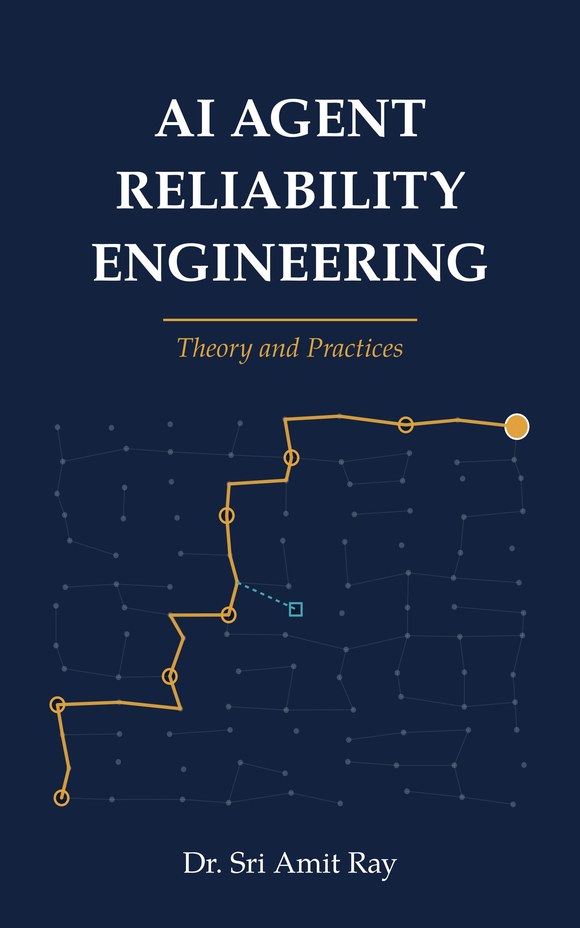
The full-color PDF eBook has 380 pages, 44 figures, 40 tables and 23 code listings, with a clickable table of contents and searchable text. The companion laboratory v1.0.0 (80 unit tests) and the Forms Workbook are attached inside the PDF; the code is also at github.com/compassionate-ai-lab/ai-agent-reliability. ISBN 978-81-69641-40-1 (First edition, 2026).
Buy the Full-Color eBook (PDF) · Rs 950/- INR ($12.00 USD)
Instant download after checkout
Questions readers ask
What does the book mean by reliability?
The accepted mission: a task completed with the specified outcome, valid authority, every mandatory condition satisfied and enough verification evidence, within its time and resource budget. A fluent final message is not counted as success.
What is the Agentic Reliability Index (ARI)?
An engineering proposal developed in the book: seven core protocols for outcomes, repeatability, recovery, control, state, multi-agent coordination and registered stress, plus three architectural views. Each states its scoring unit, success condition and confidence treatment (Chapter 6, Appendix B).
Is there code?
Yes. The companion laboratory implements the running example, FlexiAgent, with SQLite-backed local services and no network calls. Release 1.0.0 has 80 unit tests and is attached inside the PDF and published at github.com/compassionate-ai-lab/ai-agent-reliability.
Does the book make claims about particular AI models?
No. Numbers come from analytical teaching examples and from the supplied offline simulator, and both are labelled. The book describes the experiments still needed in model-driven and customer environments.
How do I receive the eBook?
Buy through the secure checkout and download the full-color PDF. It opens on any computer, tablet or phone, and the companion files are attached inside it. The price is Rs 950/- INR ($12.00 USD).