Book Review · CompassionateAI Foundation
The Superintelligence Race and AGI: Global Power and Strategies for the Future
A strategist’s guide to the decades in which AI may match and then exceed human ability, written by the founder of the Compassionate AI Lab. We read it for what it says about power, about the people least able to protect themselves, and about the institutions the world has not yet built.
Instant PDF download after checkout
Disclosure: the CompassionateAI Foundation for Global Peace was founded by Dr. Sri Amit Ray, the author of this book. We have tried to describe the book fairly, including where it is demanding; every figure quoted here is taken from the book and can be reproduced with its companion code.
Our assessment
Most writing about the race to artificial general intelligence asks who will win it. The Superintelligence Race asks what winning should mean, and for whom. It treats the timing of AGI as genuinely uncertain, maps the forces that could speed it or stall it, follows power as it shifts between companies and countries, and ends with a roadmap to 2050 judged by a single standard: whether suffering is reduced and dignity protected. For a foundation devoted to compassionate AI, that standard is the heart of the book, and it is applied with unusual rigour.
- Scope: technology, geopolitics, economy, law
- Method: scenarios, signposts and worked models
- Standard: progress judged by human consequences
Three words that organize everything
Each chapter opens with an epigraph, and the first sets the terms for the whole book: “Capability tells us what a system can do. Authority tells us what it may do. Accountability tells us who answers when it does it. The future will be decided in the space between the three.” The book returns to these three words in every domain it touches, from a hospital ward to a nuclear command chain, and its diagnosis is consistent: harm follows when authority outruns demonstrated capability, or when no one can be made to answer.
What makes the framing useful rather than merely elegant is that it is turned into tools. The Capability–Authority–Accountability Map asks for one row per consequential function, records the evidence, the permission and the person accountable, and flags three failures by name: over-delegation, unsanctioned use and unanswerable power. Twenty such tools follow, each reproduced as a worksheet in the Companion Workbook.
What could slow the race: the six walls
The book takes seriously both the case for rapid progress and the case against it. Chapter 4 sets six drivers of progress against the six walls identified by Google DeepMind in 2026: data exhaustion; resources such as investment, energy, chips and minerals; the limits of today’s paradigm; research becoming harder; regulation and backlash; and the abstraction barrier. Its conclusion is measured: no single wall is likely to stop progress outright before 2030, but the walls will slow it unevenly, fast where data can be checked, as in mathematics and code, and slow where the physical world, tacit knowledge or human institutions are involved.
The arithmetic is shown rather than asserted. With chips allowing 1.8-fold growth a year but power and efficiency limiting physical compute to 1.61×, and algorithms halving the cost of a given capability every eight months, effective growth is about 4.6× a year; it is still 4.0× if power does not grow, and 2.7× if algorithmic progress halves. The point is not the forecast but the method: knowing which wall binds tells a government where its own policy can move the curve.
Four futures, and the choices that survive all of them
Chapter 23 builds four scenarios on the two uncertainties the book treats as decisive: how fast capability advances, and how concentrated control of it becomes. Each is followed to 2030, 2035 and 2050, in better and worse versions.
Concentrated AccelerationFast capability, concentrated control: two or three laboratories reach systems that match skilled professionals by 2030, and their governments treat them as strategic assets.
Turbulent AbundanceFast capability, distributed control: open models stay close behind the frontier and benefits spread quickly, along with the risks.
Platform PlateauSlow capability, concentrated control: progress stalls at the walls while a few platforms consolidate the channels through which AI reaches people.
Gradual DiffusionSlow capability, distributed control: many countries build AI for their own languages and needs with open models and public investment.
Horizontal: concentration of control · Vertical: pace of capability
The value of the exercise lies in what survives every scenario. The book names nine robust strategies: build evaluation capacity; secure operational sovereignty; make institutions resistant to capture; invest in safety science; prepare ways of sharing the gains; form durable human capability; build international institutions in phases; protect a shared basis of fact; and keep registers of the signposts that show which future is arriving. These become the backbone of its roadmap to 2050.
Power, and who it reaches
Two analyses stand out for anyone concerned with fairness between and within nations.
Institutions, not chips, often set the limit
Chapter 11 models national AI power as limited by its scarcest ingredient. A country with compute for 100 AI-enabled public functions, skilled people for 40 and institutional capacity for 30 can deploy only 30. Buying more compute changes nothing; strengthening institutions to support 40 raises what it can do by a third. For the Global South the message is hopeful: a country with modest compute but strong institutions can gain more from rented frontier capability than a richer one with weak institutions.
A benefit that never reaches people is not a benefit
Chapter 17 follows a regional “compute dividend” paid from the revenue of AI data campuses. The first payments were about €140 per adult, too small to matter, and about 18% of eligible adults never received them, while the households nearest the campuses bore higher electricity bills and lost farmland. Measured against the burden it was meant to share, the scheme reached 0.19 of it; redesigned around automatic payment, local compensation and public services, it reached 0.97. Every mechanism, the book concludes, should be tested for whom it fails.
An institution the world does not yet have
The book’s most ambitious proposal is an International AGI Agency, offered as a design for negotiation rather than a finished treaty. It would cover only the most capable systems, defined by training computation and evaluated capability, and would combine six functions: a registry of the largest training runs and data centres, pre-deployment evaluation by accredited evaluators, verification through chip registries and inspections, a 24-hour incident centre, pooled safety research, and an access and benefit programme for developing countries.
The author is realistic about the obstacle. No such institution can work without both the United States and China, and history suggests that rivals cooperate only when they share a perception of danger, can verify each other, keep their core interests and maintain channels for crises. The arithmetic of Chapter 21 shows why verification is central: an agreement holds only if detection multiplied by the penalty exceeds the gain from cheating. A detection rate of 0.32 fails; independent layers that raise it to 0.85 make the agreement rational to keep.
What the roadmap asks of each of us
The roadmap’s first phase, Foundations, runs from 2026 to 2030. It gives each group of actors concrete work rather than general exhortation.
Governments
Evaluation institutes, a sovereign minimum of compute for essential services, procurement reformed around evidence and exit, and rights for people affected by AI to know, to an explanation, to review and to remedy.
Chapters 12, 19, 24
Companies
An annual 30-Day AGI Resilience Programme, authority profiles for every consequential agent, fewer single-provider dependencies, and a rebuilt ladder of skill for beginners.
Chapters 16, 20
Frontier developers
The Safe RSI Protocol and the Alignment Protocol with external verification, support for binding standards, and commitments to share windfall gains.
Chapters 6, 10, 17
Researchers
Evaluations that resist systems detecting that they are being tested, interpretability for deception, and validated methods of control.
Chapter 10
International bodies
The first phase of the International AGI Agency: common evaluation standards, incident reporting and shared safety research, with crisis channels between frontier states.
Chapters 14, 21
Citizens and families
A shared way of finding out what is true, protection of mental privacy, and safeguards for children and vulnerable adults who use AI companions.
Chapters 9, 18
Points for discussion
A fair review should also say where readers may want more, or may disagree.
- The scale of the project. Covering technology, geopolitics, economics and law to 2050 in one volume means that some chapters introduce fields that deserve books of their own. The references and the forecasts register in Appendix D point the way.
- Proposals that need political will. An International AGI Agency, shifts in the tax base and distribution at scale all depend on cooperation that does not yet exist. The book shows the conditions under which it could; it cannot guarantee them.
- Illustrative numbers. The worked cases use values chosen to be checked by hand, and the book says plainly that they describe no real organization or city. Readers must bring their own data.
- Questions left open by design. On whether machines could be conscious, the book reports the evidence and the uncertainty rather than taking a side, and asks institutions to prepare for questions that cannot yet be answered.
Why it matters to the work of compassionate AI
For this Foundation the book’s closing argument is its most important. Compassion, it insists, is not a feeling attributed to machines but three commitments that can be observed and checked: attention to suffering, priority to avoid serious and irreversible harm, and care for those least able to protect themselves. A compassionate superintelligence would need compassion in its objective rather than as a filter added afterwards, the humility to preserve human authority and reversibility, and verification rather than assertion. And progress itself, the book concludes, should be judged not by benchmark scores or investment but by whether suffering is reduced, dignity protected and the vulnerable included.
Get the book
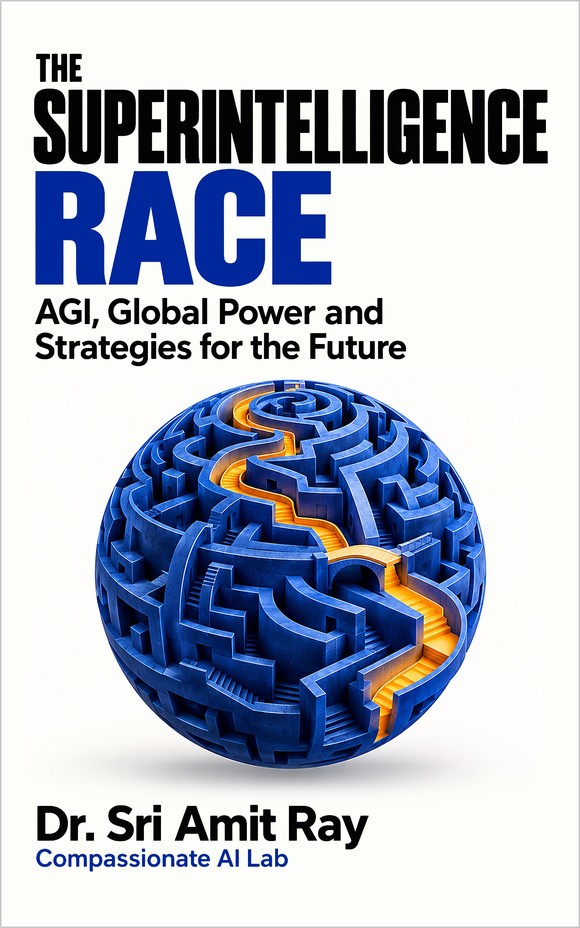
The full-color PDF eBook has 414 pages, 32 color figures, boxed tools and protocols, a clickable table of contents and searchable text. The companion code and the Companion Workbook are attached inside the PDF; the companion code is also on GitHub at compassionate-ai-lab/superintelligence-race. ISBN 978-81-69641-38-8 (First Edition, 2026).
Buy the Full-Color eBook (PDF) · Rs 950/- INR ($12.00 USD)
Instant download after checkout
Frequently asked
What are the six walls?
Data exhaustion; resources (investment, energy, chips and minerals); paradigm limits; research becoming harder; regulation and backlash; and the abstraction barrier. Chapter 4 examines each, with its counter-argument and the signposts to watch.
What is the International AGI Agency?
The author’s proposal for an international institution covering only the most capable AI systems, with a registry, pre-deployment evaluation, verification, incident response, pooled safety research and an access programme for developing countries (Chapter 21).
What is the Heatwave Night?
The case at the end of the book: a heat emergency in 2033 in which every available option harms someone. It shows how protections agreed in advance, and a stated order of comparison, make a compassionate decision possible under scarcity.
Is there material for workshops and courses?
Yes. The Companion Workbook reproduces all six protocols and twenty tools as worksheets, including a Scenario Workbook for a half-day or one-day session with a leadership team.