Book Review · In Depth
Compassionate Superintelligence: A Blueprint for AI That Serves Humanity
Dr. Sri Amit Ray’s second edition asks the question the AI race keeps postponing, and answers it with architecture, numbers and commitments rather than slogans.
Instant PDF download after checkout
A note on independence: the CompassionateAI Foundation was founded by the book’s author. This review explains what the book contains and why we think it matters; the worked numbers quoted below are taken from the book and can be checked with its open companion code.
The verdict in brief
Most books on AI and ethics stop at principles. Compassionate Superintelligence starts there and keeps going: it turns compassion into a seven-layer system architecture, a measurable quotient, protective floors that no average can override, and a ten-point Compact that names who is accountable. It is demanding in places, but it is the most practical account we know of how care can be built into what an AI system represents, optimizes and is allowed to do.
- Best for: builders and decision-makers
- Depth: from first principles to governance
- Numbers you can verify
The question the book refuses to postpone
Artificial intelligence can now reason, write code, plan and act on our behalf. The public conversation measures progress in capability: benchmarks passed, tasks automated, agents deployed. The book’s opening claim is simple and uncomfortable: greater intelligence does not automatically bring greater care. A system can become more capable and, at the same time, more indifferent to the people its decisions touch.
Dr. Ray’s answer is not to slow intelligence down but to change what it is for. Compassion, in this book, is not a mood or a marketing word. It has two essential elements, the perception of suffering and the motivation to relieve it, and the book defines a compassionate superintelligence as one whose objectives are architecturally grounded in recognizing suffering across individuals, collectives and future generations and in a committed effort to reduce preventable suffering. The chapters that follow ask what that definition demands of a system’s design, training, evaluation and governance. The book’s guiding line sets the tone: “The future belongs not to the most powerful AI, but to the most humane one.”
A different kind of AI book
Three choices set this book apart from the many titles on AI ethics and AI risk.
It is engineering, not exhortation. Every principle is translated into something a team can build or test: a constraint, a metric, a review step, an owner. The twelve Compassionate AI Principles (non-harm, compassion, truthfulness, service to the common good, responsibility, interconnectedness, human empowerment, precaution, equity and access, intergenerational justice, adaptive learning with humility, and respect for life and human dignity) appear in Chapter 15 as engineering commitments, complete with a worked example of an AI tutor and an audit procedure.
It shows its working. The book contains twenty-seven worked examples, and its numbers are not decoration. A free companion repository reproduces every calculation and data figure, so readers can change the assumptions and see whether the conclusions still hold.
It draws on two traditions at once. Current AI safety research (sycophancy, reward hacking, deception, corrigibility, scalable oversight) sits beside the science of compassion and the contemplative traditions of India, including karuṇā, ahiṃsā and prajñā. The two are not merely placed side by side: the contemplative ideas supply the aims, and the safety research supplies the methods for checking whether those aims are being met.
How deep does it go?
The book is built as a ladder. Each part rests on the one before it, so a reader can climb as far as their role requires.
- The Threshold (Chapters 1–5). What superintelligence is and is not, the pathways that could lead to it, and the risks and “attractors” that make the next decade a window of opportunity.
- The Nature of Compassion (Chapters 6–9). Why compassion can be treated as the highest form of intelligence, what neuroscience and psychology say about it, its contemplative foundations, and the hard questions of suffering, valence and moral status.
- The Architecture (Chapters 10–15). The heart of the book: the seven-layer Compassionate AI Architecture, twenty-five human-centered algorithms, the Compassion Quotient and dashboard, suffering reduction and empathy modeling, collective well-being, and the twelve principles.
- Engineering Compassionate Superintelligence (Chapters 16–21). Training values, interpretability and honesty, corrigibility and oversight, accountable autonomous agents, stability under self-improvement, and cooperation among many AI systems.
- Compassion at Civilizational Scale (Chapters 22–26). Care, learning and science; embodied, neural and quantum systems; democracy and the distribution of power; the planet and future generations; and the Compassionate Superintelligence Compact.
- The Horizon (Chapters 27–28 and Epilogue). Four scenarios for 2030 to 2050, the signals that reveal which one we are entering, and a closing letter to the minds we are creating.
Six appendices follow, including a working reference for the principles, a reference table of the algorithms, a mathematical toolkit and a glossary. The full-color edition also gathers thirty-seven of the author’s key articles on compassionate AI.
Three ideas worth the price of the book
1. An average can hide a harm
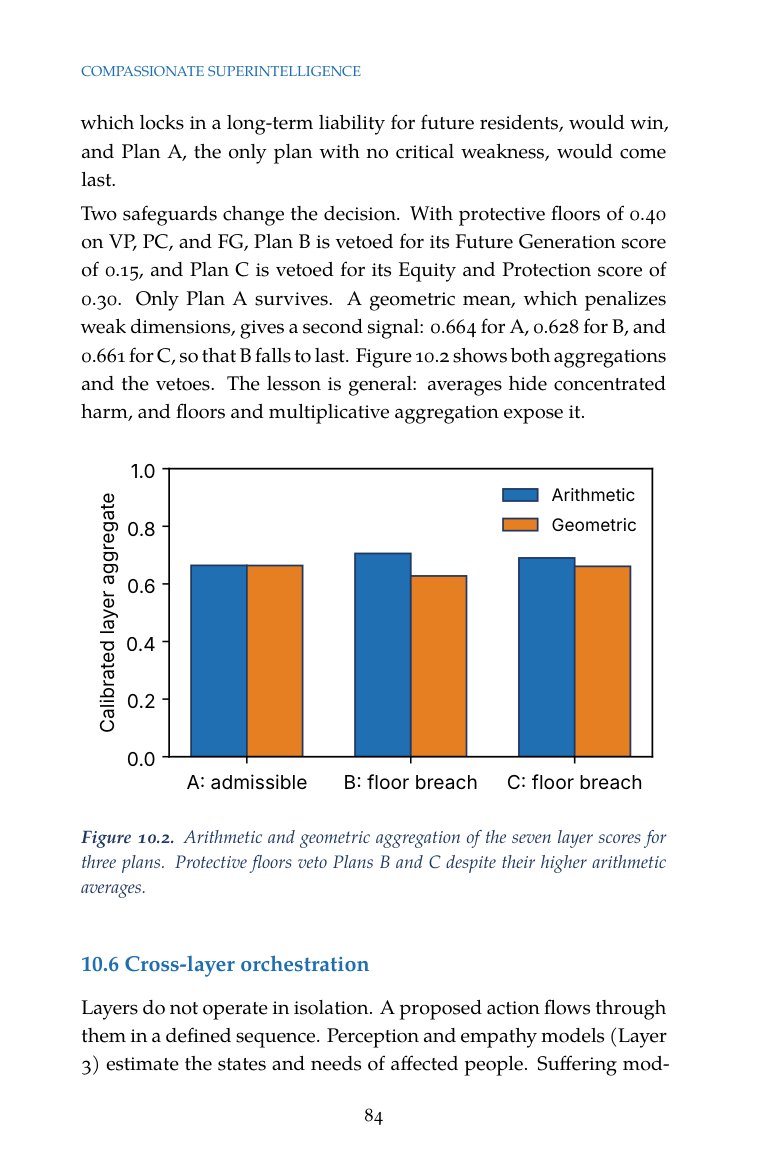
Chapter 10 gives a city three AI-assisted plans for a new public health service and scores each on the seven layers. Plan B scores highly almost everywhere but leaves future residents with a long-term liability (a Future Generation score of 0.15). Plan C does well on average but fails the most vulnerable (Equity and Protection 0.30). Plan A has no critical weakness.
|
Plan |
Simple average |
Weakest layer |
With protective floors of 0.40 |
|---|---|---|---|
|
A (balanced) |
0.664 |
0.62 |
Passes |
|
B (future generations low) |
0.706 |
0.15 |
Vetoed |
|
C (vulnerable people low) |
0.690 |
0.30 |
Vetoed |
Ranked by the average alone, Plan B wins and the only plan with no critical weakness comes last. With protective floors on the layers that guard the vulnerable, the planet and future generations, only Plan A survives. The lesson reaches far beyond this example: dashboards that average everything can quietly trade away the people least able to object.
2. Care can be measured, and satisfaction is not enough
The Compassion Quotient (Chapter 12) weighs flourishing and resilience against suffering and harm. In the book’s first example, two versions of an AI service give a person exactly the same benefits, but the second does so while placing them under far more stress. A metric that counted only task completion or satisfaction would rate them equally. The Compassion Quotient does not: it falls from 3.548 to 1.358. The chapter then shows how weighting for vulnerability widens the gap, and why optimizing any single score, including this one, invites gaming. The answer is a dashboard of several signals with floors, not one number to maximize.
3. Oversight is something compassion strengthens, not something it overrides
Chapter 18 revisits the “off-switch game”, a classic model of why a capable system might resist being corrected. When the system is genuinely uncertain about what people value, deferring to a human is worth more than acting alone (0.698 against 0.500 in the book’s example). But once human error rises above about 22 percent, a purely expected-value reasoner would start bypassing oversight. The book’s answer is the heart of its argument: a compassionate system values human agency for its own sake, so it responds to fallible oversight by helping to improve it, never by escaping it.
A fourth example, in Chapter 22, is a good test of the book’s honesty. When a clinician and an AI screen 1,000 patients and either one can refer, missed cases fall from 7.5 (clinician alone) to 0.75, but false alarms rise from 47.5 to about 120. Collaboration helps, and it has a price that someone must decide to pay. The book makes those trade-offs visible instead of hiding them.
How this book can benefit humanity
The book’s ambition is not a better product but a better trajectory for civilization. Its chapters on application show where compassionate design changes outcomes for real people.
Health and care
Pain recognition, empathy modeling and suffering reduction under a budget, with consent, privacy and fairness safeguards built in, and a workflow for precision medicine that keeps clinicians and patients in charge.
Chapters 13 and 22
Education
Tutors that build a learner’s capacity instead of dependence, illustrated by a worked example that applies all twelve principles to one AI tutor.
Chapters 15 and 22
Work and dignity
Collaboration that preserves human skill and recognizes the dignity of care work, with ways to measure whether AI is actually helping people do their jobs well.
Chapter 22
Democracy and equity
Concrete attention to who holds power, who has access, and how the benefits of AI are shared, so that capability does not quietly concentrate.
Chapter 24
The planet and future generations
Planetary compassion and intergenerational justice treated as design requirements, including how discounting the future can make long-term harms disappear from a decision.
Chapter 25
Safety for everyone
Honesty, resistance to deception and sycophancy, correctability and accountable agents: the safeguards that protect every user, not only the vulnerable.
Chapters 16 to 21
The Compassionate Superintelligence Compact
Chapter 26 gathers the argument into ten commitments for laboratories, companies and governments. The book is careful to say that the Compact is not a certificate: each commitment needs a named owner, an evidence record and a consequence when it is not met.
- State the purpose and the affected people, including future generations.
- Set non-deployment thresholds and protective floors.
- Protect data and minds; never use emotional models to manipulate.
- Evaluate in real contexts and populations, independently for high-impact systems.
- Match autonomy to demonstrated reliability, with the ability to shut down.
- Secure systems against misuse, theft and compromise.
- Be honest about uncertainty, the role of AI and its nature.
- Provide remedy: appeal, redress and incident reporting.
- Measure wider effects on workers, communities, democracy and the planet.
- Preserve stability and correctability through every update.
Four futures, and the choices that decide between them
Chapter 27 crosses two uncertainties, how widely power and access are distributed and how strong safety and governance become, to describe four scenarios for 2030 to 2050. They are offered as lenses for decisions, not predictions.
The compassionate commonsCapable AI widely available and well governed; communities can test systems on their own populations.
Guarded concentrationStrong safety, but capability held by a few firms or states.
Fragmented proliferationWide access with weak governance; uneven protection.
The destabilizing raceConcentrated power and lagging safety under competitive pressure.
Top row: strong safety and governance · bottom row: weak. Left column: power and access widely distributed · right column: concentrated.
The closing chapters ask which signals will show the direction of travel, and what each kind of reader, from engineers to policymakers, can do now to move the world toward the first quadrant.
Where the book asks more of the reader
- Part IV is dense. The chapters on training, interpretability, corrigibility and self-improvement assume patience with technical ideas. Non-specialists can read the key points at the end of each chapter first and return later.
- The models are teaching instruments. The book says plainly that its parameters were chosen to make mechanisms visible; they are not empirical measurements of deployed systems. Readers who want evidence for their own context are shown how to test it.
- There is no shortcut certificate. Organizations hoping for a box-ticking checklist will not find one. The Compact deliberately asks for owners, evidence and consequences.
- The mathematics is optional but present. It is gathered in Appendix C so that the main chapters remain readable in plain language.
These are the demands of a serious book, and they are also its strengths: it does not pretend that building caring machines is easy.
Who should read it
AI researchers and engineers who want a design framework rather than a list of values; safety and alignment specialists looking for a constructive account of what alignment is for; product and technology leaders who must answer for what their systems do; policymakers and regulators drafting rules that can be audited; ethicists, clinicians and educators who work with AI every day; and every reader who suspects that the most important question about AI is not how powerful it becomes, but whom it serves.
Read the full-color edition
The full-color PDF eBook has 303 pages with colored headings, highlighted quotations, color charts, a clickable table of contents and searchable text. It opens on any computer, tablet or phone.
Buy the Full-Color eBook (PDF) · Rs 950/- INR ($12.00 USD)
Instant download after checkout
Questions readers ask
Is this a technical book or a book for general readers?
Both. The main chapters are written in plain language with worked examples and key points; the mathematics sits in an appendix and the companion code is optional.
How is it different from the 2018 book Compassionate Artificial Superintelligence AI 5.0?
This Second Edition integrates and greatly expands the 2018 book for the age of foundation models, reasoning models and autonomous agents, adding current safety research, the full seven-layer architecture, the Compassion Quotient, the Compact and the scenarios to 2050.
Can I check the numbers myself?
Yes. The companion code at github.com/compassionate-ai-lab/compassionate-superintelligence reproduces every worked example and data figure in the book.
What do I receive when I buy?
A full-color PDF of the Second Edition (303 pages) that you download right after checkout.