
Book Review · CompassionateAI Foundation
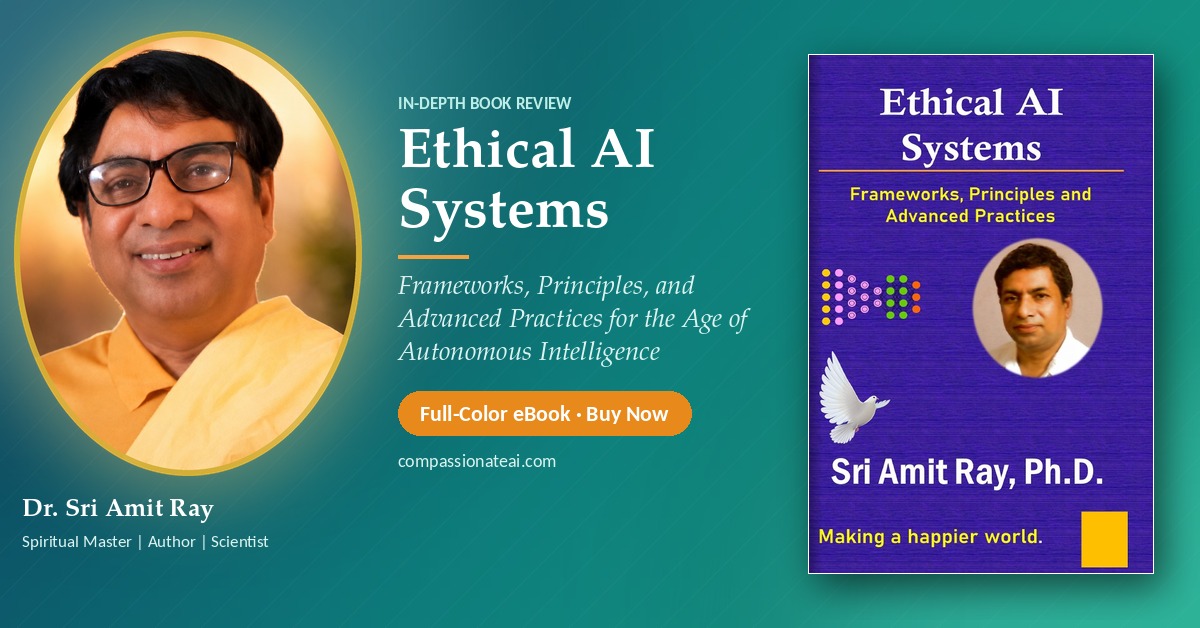
Ethical AI Systems: Frameworks, Principles, and Advanced Practices for the Age of Autonomous Intelligence
The revised expanded edition of a book first published in 2022, rebuilt for a world in which AI systems no longer only answer but act. We read it for one question above all: when an intelligent system acts on someone’s behalf, who answers for what it does?
Instant PDF download after checkout
Disclosure: the CompassionateAI Foundation for Global Peace was founded by Dr. Sri Amit Ray, the author of this book. We have tried to describe the book fairly, including where it asks a great deal of its readers; every number quoted here is taken from the book and can be reproduced with its companion toolkit.
Our assessment
Many books on AI ethics end where the hard work begins: with a list of principles. Ethical AI Systems starts there and keeps going, asking for each principle what control implements it and what evidence shows the control operated. Its central idea is an order of decision: rights and severe-harm limits decide what is admissible, and benefit decides only among the actions that remain. Applied to hospitals, hiring, lending, travel agents, care robots and flood response, that order turns compassion from a sentiment into a specification that can be tested. For a foundation devoted to compassionate AI, that is the book’s most important contribution.
- Scope: data, models, agents, robots, institutions
- Method: principle, control, evidence
- Standard: harm limits before benefit
Harm limits first, then benefit
The book’s ethical method is easy to state and demanding to apply. First identify the actions that violate rights or create unacceptable harm, and exclude them. Then compare the benefits of the actions that remain, counting the costs of delay and refusal as well. Finally, require an owner and a repair path for whatever is still uncertain. Dr. Ray presents this sequence as ahimsa made operational: a discipline of choosing and repairing, not merely of refusing.
Chapter 5 gives the idea a precise form. It defines an admissible set of actions that satisfy mandatory rights and authorisation conditions and keep every protected group’s harm within a justified limit across the plausible states of the world. Benefit optimisation then works only inside that set. The book is careful about its own claim: this is a proposed robust decision rule, its guarantee extends only to the assumptions actually specified, and an unknown severe harm must never be recorded as zero.
Chapter 1 shows why the order matters. A home-care agent that cannot verify a pharmacy must not send an unverified order, but it must not silently abandon the patient either. It should preserve the request, contact an authorised clinician and tell the patient in a language they can read. In the book’s words, a protective refusal must carry the person toward help.
Seven levels of responsibility
The service pyramid, carried over from the first edition and sharpened here, distributes responsibility across seven levels: foundations (compute, energy and supply chain), data, model, system, deployment, the service interface and, at the apex, society and future generations. Each level receives its own code of duties, refusals and failure modes, and Appendix B turns them into a checklist.
The worked hospital triage example in Chapter 3 shows why this is more than a diagram. The cloud provider owes energy and outage reports; the vendor owes validation by age, sex, language and deprivation; the triage nurses need an override that is one action at the bedside and feeds a review. Otherwise, the book observes, the people closest to the harm carry the burden without the power. A final section asks how responsibility survives when systems are retrained, merged or delegated to other agents.
- Part I · Foundations. The ethical mandate, the frameworks and binding instruments as of 29 October 2026, and the service pyramid.
- Part II · Data and Models. Data ethics and the labour in the data chain; bias, fairness and the ten indexes; transparency, explainability and traceability.
- Part III · Systems that Act. Agentic accountability, consent and oversight; safety, security and containment; human–robot interaction and roboethics.
- Part IV · Domains and Institutions. Health and drug design; military, disaster and public services; governance, measurement and the road ahead.
Three ideas worth the price of the book
Each of these can be checked against the book’s figures and reproduced with its companion code.
An average cannot clear a rights failure
Chapter 5 scores a recruitment model on the ten ethical AI indexes. The scores run from 52 for oversight to 83 for hostility, and the weighted composite is 66.64: above the illustrative floor of 40 on every index, below the release threshold of 75, so the decision is HOLD. The book’s conclusion is not to improve the average but to fix the oversight gate and extend subgroup testing for older and disabled applicants, then re-score. An unlawful rejection rule would fail even if every index scored 95.
Autonomy is a ladder earned with evidence
Chapter 7 replaces the on/off question of automation with five rungs, from 0 (suggest only) to 4 (bounded end-to-end autonomy for a low-impact, fully reversible workflow). A matrix of impact and reversibility sets the highest rung allowed, and the book insists it is a ceiling, not a permission. In the travel-agent example, holding a flight is rung 2, payment under budget rung 3, any change to identity documents rung 1, and booking with an unverified supplier rung 0.
Ethics for agents lives outside the model
The travel agent’s safeguards do not depend on the model being well behaved; they depend on an envelope enforced around it: budgets, scoped credentials, a verified merchant list and a one-action stop. The red-team table for a coding agent in Chapter 8 makes the same point with five attacks, from prompt injection in a dependency README to cascading delegation, each matched by a control, an owner and a regression test that outlives the model.
How this book can benefit humanity
The book’s domain chapters apply one framework to settings where people are most exposed. These are the mechanisms we found most valuable.
Patients
A sepsis alert that advises but never orders, is calibrated per subgroup and can be suspended by a named clinician in a single action.
Chapter 10
Job seekers
No automatic rejection without a human gate, and subgroup testing for age and disability before release.
Chapter 5
Borrowers
A denial letter with disclosure, a specific and actionable reason, the data used and a route to human review within 30 days.
Chapter 6
People living with dementia
A companion robot with local processing, a visible recording light, repeated disclosure that it is a machine, and human visits it never replaces.
Chapter 9
Communities in disaster
A flood agent that prepares options while district officers decide, with messages in local languages and a paper fallback.
Chapter 11
Data workers
Lawful, fair collection and attention to the people who label and prepare data, recorded in the collection index.
Chapter 4
Where the book asks more of the reader
A fair review should also say where readers will have to work.
- It asks for evidence, not agreement. Readers who want a list of values to endorse will find instead a demand for owners, thresholds, logs and tests. That is the book’s strength, and it takes effort to apply.
- Instruments change. The legal chapters are dated to 29 October 2026, and the book says plainly that scope and application dates must be checked for each deployment. It is not legal advice.
- Illustrative numbers. The worked cases and index weights are teaching examples, labelled as such. Organisations must justify their own weights, floors and thresholds.
- Some questions stay open. On machine consciousness and experienced compassion, the book asks for evidence distinct from fluent emotional language rather than taking a side.
Why it matters to the work of compassionate AI
The book closes with twelve commitments, each written to be auditable: prevent severe, foreseeable and avoidable harm, including harm through omission; keep responsibility human; scale autonomy to risk; obtain real consent; protect the vulnerable with stronger defaults; and leave every system better governed than you found it. A roadmap from 2026 to 2030 turns them into four phases: establish, embed, verify and lead.
For this Foundation the decisive line comes near the end: doing no harm is the first principle, and also the most practical one, because the harms we prevent are the benefits we keep. A system that cannot be trusted to stop cannot be trusted to run. The book shows, chapter by chapter, how to build systems that can be trusted to do both, and that is why we recommend it to engineers, boards, regulators and every citizen who will live with AI that acts.
Get the book
The full-color PDF eBook has 167 pages, 9 color figures, 17 tables, boxed key points and 34 epigraphs, with a clickable table of contents and searchable text. The Python companion toolkit and the Forms Workbook are attached inside the PDF; the code is also on github.com/compassionate-ai-lab/ethical-ai-systems. ISBN 978-81-69641-39-5 (Revised Expanded Edition, 2026).
Buy the Full-Color eBook (PDF) · Rs 950/- INR ($12.00 USD)
Instant download after checkout
Frequently asked
What is the service pyramid?
A map of responsibility across seven levels of an AI service, from foundations, data and model to system, deployment, the service interface, and society and future generations. Chapter 3 gives a code of ethics for each level; Appendix B is the checklist.
What are the ten ethical AI indexes?
Cage, traps, bias, hostility, source diversity, collection practices, transparency, anonymisation, augmentation and human oversight, developed in the Compassionate AI Lab for data training and model evaluation (Chapter 5, Appendix A).
How is this edition different from 2022?
It adds the ten indexes, an agentic layer of accountability, consent, oversight and containment, and a measurement and governance programme, with nine new figures, a Forms Workbook and a tested toolkit.
Is the companion code free?
Yes. The standard-library Python toolkit and its 10 regression tests are attached to the PDF and published on GitHub under the MIT License.